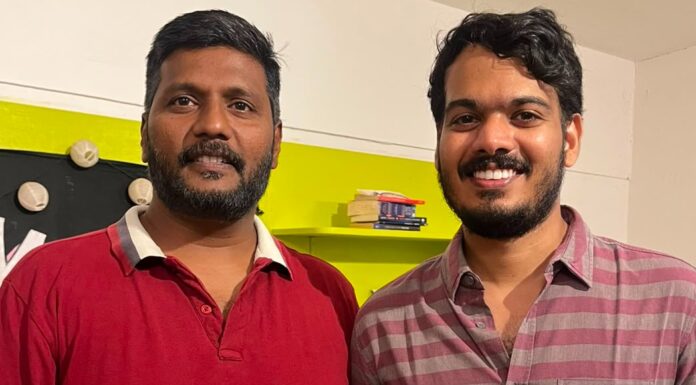
Promptly at 10:00 a.m., Achuthan, the owner of Thanjai Tolstoy Bookshop, inaugurated the discussion by referring to an idea from American writer George Saunders’ Swim in a Pond in the Rain. Saunders compares the relationship between a writer and a reader to the circular ripples created by a small stone thrown into one bank of a pond, eventually reaching the opposite shore. Achuthan explained that the literary space fostered by Thanjai Tolstoy Bookshop stands as a living example of this relationship between writer and reader.
Ajithan had arrived in Thanjavur that Sunday morning after attending the Vishnupuram–Kumaragurubaran Award sessions in Chennai the previous day. He had travelled overnight on the Uzhavan Express.
Looking at the rows of chairs arranged in straight lines, Ajithan asked, “Could we arrange them in a circle instead?” With two readers joining at the last moment, the seating eventually resembled an oval rather than a perfect circle. Thus began the discussion on his short story collection, Aasirvaadham Studios.
The premises housing Tolstoy Bookshop carried the languor of a Sunday morning. Across the street, however, the church was bustling with worshippers attending the morning service. Among those present at the discussion were writers Keeranur Jaqir Raja, K. J. Ashok Kumar, and poet Kaviyarasu Nesan. Beginning from one end of the oval, each reader shared their experience of reading the collection. The discussions started with stories such as Aval (“She”), Naragam (“Hell”), and An Indian Spiritual Experience, before moving on to George Bushshoom Vattapperum and Maridjan’s Body.
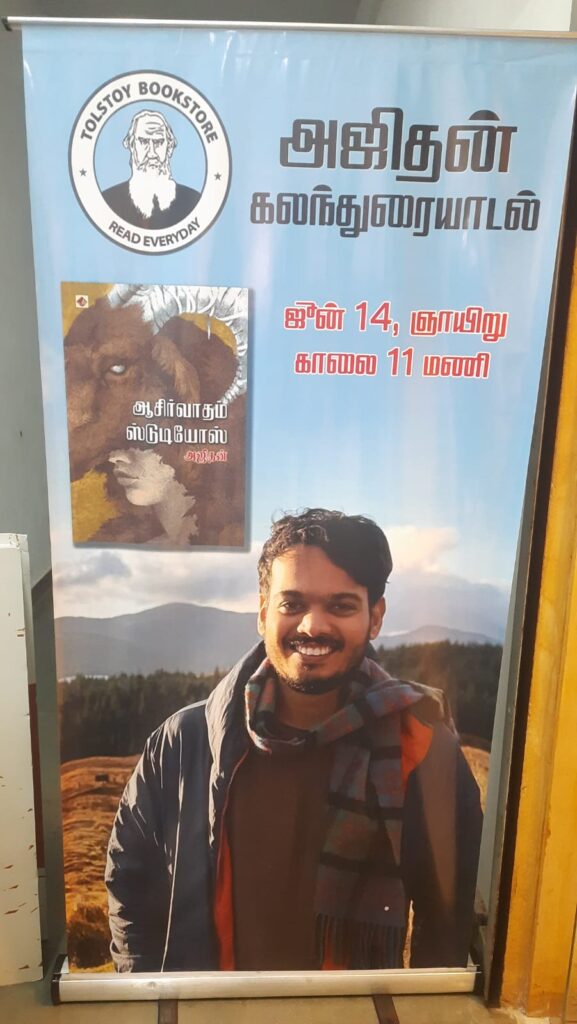
When K. J. Ashok Kumar remarked, “You seem to explain everything to the reader, don’t you?”, Ajithan responded by speaking about what he called his “wave of writing,” beginning metaphorically with “the cough of a volcano.” He went on to explain the distinction between Tale and Modern Tale, recalling that he had attended Jeyamohan’s three-day workshop at Vellimalai, held a few weeks earlier, where these narrative forms had been discussed in depth. He also reflected on where his own stories might fit within those categories.
Ashok then observed, “Your father (Arunmozhi) simply keeps typing away on the keyboard and a story appears. You, on the other hand, seem to immerse yourself in fieldwork before writing.” Ajithan replied that he usually begins writing only after the ending of a story has fully taken shape in his mind. There was, however, one exception in this collection—George Bushshoom Vattapperum—which began without any preconceived idea whatsoever.
Naturally, the title story, Aasirvaadham Studios, became the central focus of the session. One sensed that this was also Ajithan’s preferred subject. At one point, his smile recalled the memorable line: “Let at least four people say that Raja’s little box has gone missing.”
Several questions revolved around this story.
One reader wondered why Ajithan had chosen to portray the lives of goat herders instead of cattle-herding pastoralists. Ajithan responded only with a smile.
Another asked why, having depicted their lives in such detail, he had not written in their own dialect. Ajithan replied that, since that linguistic territory already belonged so completely to Ki. Rajanarayanan (Ki. Ra.), he had deliberately chosen to write in his own language rather than imitate it.
Readers also discussed the dialogue, “Forget it… something else has been lost between him and me,” and the story’s closing moment, where a keyboard replaces the harmonium. Ajithan explained how the shepherd’s inner liberation is revealed in the story. Returning to the earlier remark about Raja’s missing box, he said that if such a literary myth were to emerge around the story, it would only make him happy.
Another discussion suggested that Tamil short stories published before the year 2000 often displayed an emotional void, whereas later stories seemed richer in emotional experience. Responding gently to this broad generalisation, Ajithan explained how emotional states operate within his own fiction and why it would be impossible to reduce all pre-2000 Tamil short stories to a single conclusion. With calm and carefully chosen words, he invited readers to continue the discussion on the nature of emotional experience in literature.
A reader referred to the preface of the collection, where Ajithan mentions repeatedly listening to the raga Poorvi Dhanashree while writing these stories. Since he had now moved beyond that phase of life, the reader asked which raga he listened to these days.
“The same raga,” Ajithan replied.
He then described another dimension of what the raga now evokes. To explain the difference between pain and disgust, he compared the sensation of acid touching the skin with the revulsion caused by water dripping from a used leaf after a meal. Water is normally a source of comfort and relief; yet the very same water becomes repulsive when it trickles from a saliva-stained leaf. As Ajithan unfolded this comparison in his measured voice, many of the readers seemed to find answers to the questions they had carried about the story An Indian Spiritual Experience. Around half the audience nodded in agreement.
A young reader then asked about the recurring themes of rural and urban alienation in Ajithan’s fiction. Using examples from Aval and Aasirvaadham Studios, Ajithan patiently elaborated on the idea and invited the young reader to continue the conversation through essays and further correspondence.
After the event, while travelling from Thanjavur towards Thalaichangadu, I found myself reading the back cover of The Old Man and the Sea. The words written there by writer Yuvan Chandrasekar—about how profoundly emotional situations can be conveyed through language that remains free of emotional excess—perfectly captured what I had experienced during Ajithan’s conversation.
Ajithan concluded by recalling a question posed to him by the American writer and translator Peter Constantine: “Why do you write about every landscape?” He admitted that he still owed Constantine an answer. Being someone from the land of Kanyakumari, he said, the Karisal region of Tamil Nadu and the Indonesian village of Kinarejo felt equally like neighbouring landscapes to him. The limitless possibilities that such inner geographies opened within him continued to compel him to write.
May the creative world and the inner impulse that generate those ripples—while Ajithan sits, as George Saunders imagines, on one bank of the pond—continue to travel across to the readers on the opposite shore.
— Yogeswaran Ramanathan
